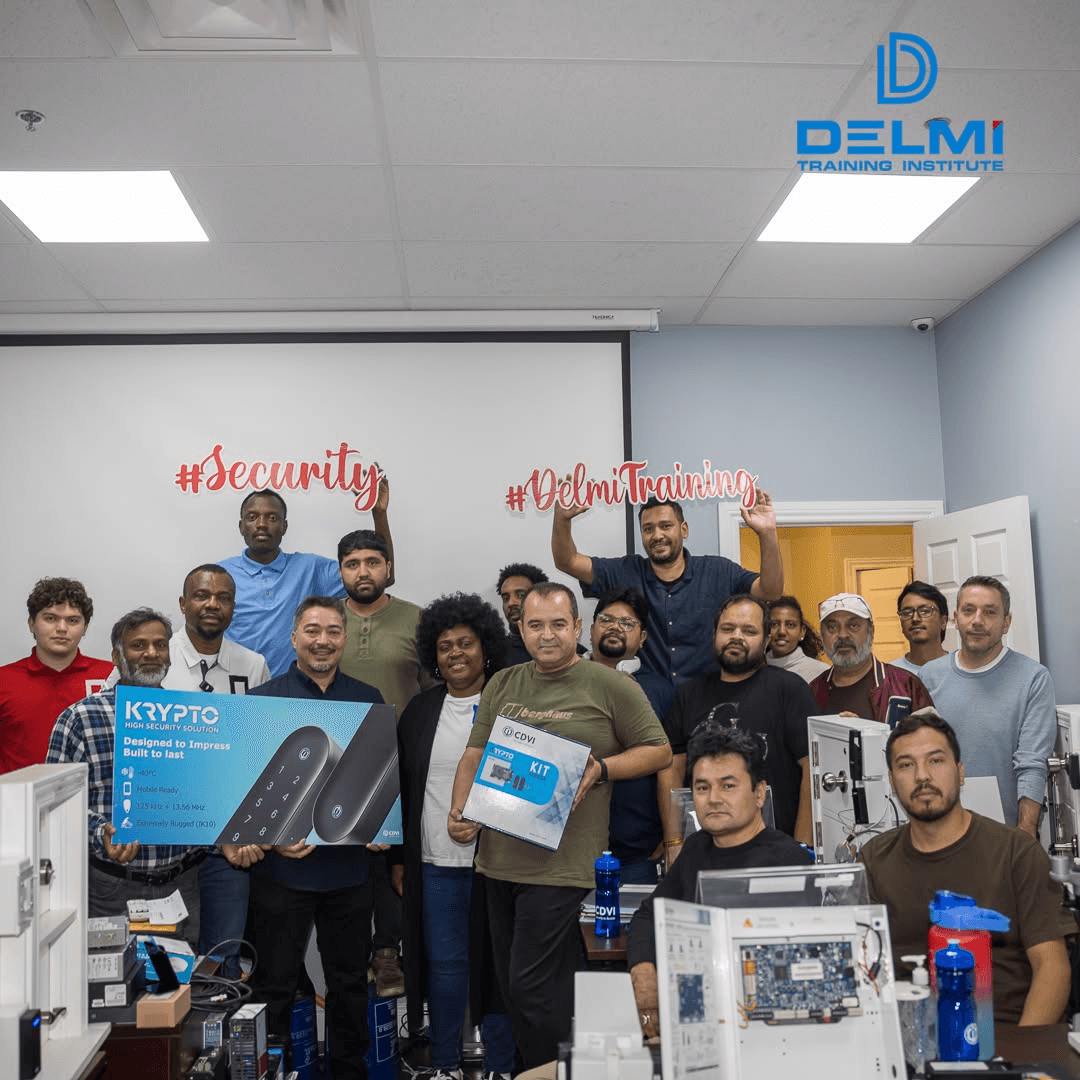
A working security system begins long before a camera appears on a screen or a credential opens a door. Behind those moments are cable terminations, power supplies, relay logic, network settings, and a technician who understands how they fit together. Delmi Training Institute in Woodbridge, Ontario, puts those connections at the centre of its teaching: students learn the principles, handle the equipment, and practise turning a diagram into a working system.
The missing bridge between theory and the jobsite
Many new technicians enter the industry with one part of the picture. They may understand a product interface without having built the cable infrastructure beneath it, or know the vocabulary of access control without ever tracing a relay through a real door. Delmi’s hands-on approach is designed to close that gap.
Training starts with the foundations: infrastructure, pathways, patch panels, terminations, testing, and the habits that make an installation serviceable. From there, learners move into CCTV, electronics, relays, access control, and networking. Each subject is connected to the work that comes before and after it, so the system makes sense as a whole.
A lab built for real decisions
Delmi’s custom electronics board turns circuit diagrams into something students can wire, test, and troubleshoot. Its published equipment list includes the Camden CX-12 Plus door interface relay, Altronix relays and timers, electric strikes, magnetic locks, and pull stations. Alongside the board’s touchless activation sensor, these components help learners follow a signal from an input device through relay contacts to the equipment it controls.
The Camden CX-12 Plus door interface relay coordinates automatic doors with systems such as access control and telephone entry. Its programmable operating modes and adjustable delays can control the sequence between releasing a lock and activating a door operator. For a learner, that makes relay logic tangible: what starts the sequence, which output changes, and why the timing matters. Camden identifies the original CX-12 as its earlier Switch Network model; the CX-12 Plus replaces that model and the CX-22.
A miniature training door turns access-control theory into a physical sequence. Students can follow the path from credential and reader to lock, request-to-exit, door position, power, and panel logic. That kind of repetition builds the confidence to approach a full-size opening with a clear method.
Fourteen camera platforms, one practical mindset
Camera training is deliberately broad. Delmi exposes learners to 14 camera systems, including Dahua, Avigilon, Axis, GSD, Hikvision, and cameras sourced from the varied channels technicians encounter in the field. The goal is not to memorize one menu; it is to learn how to mount, power, network, focus, configure, document, and troubleshoot a surveillance system.
That breadth matters for technicians who may inherit an existing installation, support a mixed fleet, or need to explain the difference between a specification and a usable result. Working across platforms teaches the underlying decisions while respecting the details that make each system different.
Access control that keeps pace with the market
Delmi’s published Access Control Technician curriculum lists CDVI, Kantech, and RBH equipment, alongside locking, relay, and power components. Working across three panel platforms gives students a way to compare how similar tasks are handled: connect an input, assign a credential, control an output, and diagnose a door that does not behave as expected.
Manufacturer learning resources can extend that practice beyond the classroom. CDVI’s Learning Zone explains credentials, locking, and access-control options, while its video tutorials give learners another way to revisit product-specific steps. Delmi also describes networking and intercom courses as being developed; availability and final equipment should be confirmed with the institute.
Safety is part of technical competence
A technician’s success is measured by more than whether a system powers up. Delmi includes Working at Heights and WHMIS training because safe practice belongs in the same conversation as tools, testing, and commissioning. Understanding the work environment helps new technicians protect themselves, their team, and the customer’s site.
Bringing the industry into the classroom
Manufacturers, integrators, and seasoned practitioners are invited into the classroom to share how systems are specified, installed, supported, and handed over. Those conversations give learners context that a manual cannot: what a site really asks of a technician, which mistakes cost time, and how a good installation earns trust.
Roland, the institute’s president, describes the purpose as filling the space between industry and the real classroom. That is the larger opportunity Delmi is pursuing: a place where the next generation can learn the fundamentals, handle current equipment, ask better questions, and enter Canada’s electronic-security and network-cabling workforce ready to contribute.
Explore the training and technical resources
Delmi’s Network Cabling Specialist course outlines its infrastructure training. The CCTV Surveillance Technician course covers camera installation and troubleshooting. Its Electronics and Relays course describes the circuit fundamentals behind security systems, and the Access Control Technician curriculum explains the panel and door work. The full course catalogue also lists WHMIS and Working at Heights training.
For further technical reading, explore CDVI’s Learning Zone and access-control video tutorials. To learn about Delmi’s teaching approach and location, visit the institute’s About Us page.
Editorial note: this company highlight combines Delmi’s published course information with classroom details and photographs supplied for the story. The miniature door, 14-camera training setup, guest sessions, and planned courses are based on those supplied details. Low Voltage Canada’s founder works with Delmi Training Institute.


